

The 6 best AI sales tools in 2026

Short answer
The 6 best AI sales tools in 2026 are Clay, Salesforge, 6sense, Karumi, Attio and Gong. Karumi is the pick if you want an AI agent that joins the buyer on a video call and demos your real product live.
Artificial intelligence is no longer just a decorative add on, but has become the engine that drives every stage of the sales process, from pipeline generation to sales team coaching.
But not all stages have evolved at the same pace. Some, like prospecting or outbound, have been natively incorporating AI for years. Others, such as the product demo, have continued to work exactly the same way: a form, a queue, a calendar, and a sales rep who sometimes arrives when the buyer's interest has already cooled off.
In this article, we analyze the 6 best AI sales tools in 2026. This is not a generic list, as we have selected one tool for each phase of the sales process so you can build a complete stack where each piece fulfills a specific function.
How we selected these tools
The market for AI sales tools is saturated. Practically any software adds an "AI powered" badge to its landing page. Because of this, we applied a clear criteria for this selection. Artificial intelligence must be the core of the product, not a cosmetic feature.
We have divided the sales process into its six most common phases and chosen the tool that best solves each one with AI as its central pillar:
- Prospecting and account research: finding the accounts that fit your ICP, obtaining reliable data about them, and building segmented lists your team can work with directly.
- Outbound and initial contact: reaching those accounts with personalized messages at scale via email and LinkedIn without making every message look like a template.
- Lead scoring and intent detection: identifying which accounts are actively researching your product category and prioritizing those with the highest probability of buying.
- Product demos and presentation: showing the product in a personalized way at the exact moment the prospect is interested, without depending on a calendar or an available sales rep.
- CRM and pipeline intelligence: managing opportunities, keeping the pipeline clean, and predicting revenue with real data instead of subjective estimates.
- Conversation intelligence and sales coaching: analyzing every customer interaction to understand what works, what does not, and replicating behaviors that correlate with won deals.
The result is a stack of six tools that cover the funnel from beginning to end. None are unnecessary and none overlap.
Comparison table: the best AI sales tools
| Tool | Sales phase | Best for | Key AI feature | Ideal team size |
|---|---|---|---|---|
| Clay | Prospecting | Sales & RevOps teams | Waterfall enrichment (150+ providers) | From solo founders to enterprise |
| Salesforge | Outbound | Sales teams & agencies | Agent Frank (autonomous AI SDR) | From 1-5 reps to agencies with multiple clients |
| 6sense | Lead scoring & intent | Enterprise marketing & sales | Signalverse (anonymous intent data) | Mid-market & enterprise (50+ employees) |
| Karumi | Product demos | B2B SaaS marketing & sales | Real-time agentic demos | From startups to enterprise |
| Attio | CRM | Startups & scale-ups | AI Attributes (AI-powered auto-fill fields) | Teams of 1 to 50 people |
| Gong | Conversation intelligence | Sales orgs with 15+ reps | Deal Likelihood Score (300+ signals) | Sales teams with 15+ reps |
1. Clay: AI Prospecting and Account Research
Best for: sales and RevOps teams that need to build hyper segmented account lists without spending hours jumping between data sources, combining automatic enrichment from over 150 providers with real time buying signals.
Clay is a sales intelligence platform that works like an AI powered spreadsheet. Its purpose is to solve one of the most persistent problems in the sales process: finding the right accounts, getting reliable data on them, and building hyper segmented lists without your team spending hours doing manual research.
What makes Clay special is its ability to aggregate data from over 100 different providers in one place. Instead of jumping between ZoomInfo, LinkedIn, Clearbit, and other sources, Clay queries all of them simultaneously and consolidates the information into a clean and complete record for each account or contact.
Key features
- Waterfall enrichment: sequentially queries over 150 data providers for each field until the correct information is found. If one provider does not have the contact's email, it automatically moves to the next.
- Claygent (AI research agent): an agent that surfs the web in real time to answer specific questions about an account or contact.
- Signals and intent data: monitors custom buying signals such as leadership changes, new hires in key roles, adoption of complementary technology, or recent funding rounds.
- Data marketplace: gives access to over 150 premium data sources from a single platform, eliminating the need to contract each provider separately.
- Sculptor: allows you to build complete GTM workflows using natural language. Instead of manually setting up filters and automations, you describe what you need and Clay builds it.
- Audiences and Ads: centralizes your data sources to create segmented audiences and syncs them directly with LinkedIn Ads, Meta Ads, and Google Ads.
- CRM enrichment: automatically keeps your CRM clean and updated by enriching existing records with fresh data and removing outdated information without manual intervention.
- AI formatting: uses AI to clean, format, and standardize unstructured data. It transforms raw information into usable fields ready for outreach or feeding into your CRM.
What sets it apart
Clay does not try to be a CRM or an outbound tool, but rather the intelligence layer that feeds both. While other tools offer a static database with information that might be outdated, Clay builds dynamic profiles that update in real time by combining dozens of sources. That difference is what allows sales teams to go from generic lists to lists that truly reflect who is ready to buy.
Its model based on actions and data credits also makes it accessible for teams of different sizes, from startups wanting to test it on a free plan to enterprise teams that need to process thousands of accounts a day.
2. Salesforge: AI Outbound at Scale

Best for: sales teams and agencies that need to scale email and LinkedIn outbound without limits on mailboxes or senders, featuring true AI personalization and built in deliverability on the same platform.
Salesforge is a sales execution platform designed to automate and scale outbound campaigns without sacrificing personalization. At a time when B2B buyers ignore mass generic emails, Salesforge bets on a model where AI writes personalized messages for each recipient based on real data.
What makes Salesforge special is that it solves the dilemma between volume and personalization. Sales teams need to send hundreds or thousands of messages a month, but each one has to look like it was written by someone who researched the prospect. Doing it manually does not scale, doing it with generic templates does not convert, and Salesforge occupies that middle ground.
Key features
- AI personalization: the AI engine generates emails tailored to each recipient using available information about their profile, company, and context. Messages are not templates with variables, they are unique texts that sound human.
- Multichannel sequences (email + LinkedIn): allows you to build cadences that combine emails, LinkedIn messages, connection requests, and follow ups in a single flow.
- Agent Frank (AI SDR): a virtual SDR that can autonomously manage the entire outbound process. This includes everything from initial prospecting to booking meetings and sending follow ups. It does not replace the human team but absorbs the repetitive work.
- Warmforge (automatic warm up): automatically warms up your email accounts before you start sending, building sender reputation with a network of real Google Workspace and Microsoft 365 mailboxes.
- Primebox (unified inbox): centralizes all email and LinkedIn replies in one place, even if the prospect replies from a different address. This eliminates the need to log into each inbox separately.
- Native multilingual support: the AI can draft messages in the prospect's language without needing to create separate sequences for each market.
- Unlimited mailboxes and LinkedIn senders: connect as many email accounts and LinkedIn profiles as you need at no additional cost. The infrastructure is modular, including Mailforge (shared IPs), Infraforge (dedicated IPs), and Primeforge (Google or Microsoft 365 mailboxes).
- Email validation: verifies email addresses before sending to reduce bounces and protect domain reputation.
What sets it apart
Most outbound tools force you to choose between volume and personalization, but Salesforge eliminates that dilemma. Its unlimited mailbox model with included warm up allows you to scale outbound without adding headcount or burning domains, which is a real problem for teams sending at scale.
3. 6sense: Predictive Lead Scoring and Intent Detection

Best for: B2B marketing and sales teams with long sales cycles that need to identify which accounts are actively researching their product category, even before those accounts have interacted with their website.
6sense is a revenue intelligence platform that helps identify which accounts are actively looking for solutions like yours, even before they have raised their hand. While most tools work with explicit data (someone fills out a form, someone downloads a whitepaper), 6sense operates with anonymous purchase intent signals that it captures through its proprietary data network.
What makes 6sense special is simple: if a company is actively searching your product category, researching your competitors, and consuming related content, you should know about it before that company contacts you.
Key features
- Signalverse (B2B signal network): captures trillions of purchase intent interactions from searches, industry publications, forums, and communities.
- Buyer journey tracking: assigns each account a stage in the buying process (awareness, consideration, decision, purchase) based on actual behavior, not sales team assumptions.
- 6AI account scoring: predictive models that analyze each account's fit, engagement level, and momentum to generate a purchase probability score.
- Anonymous account identification: detects which companies are visiting your website without them needing to fill out any forms.
- RevvyAI (conversational AI): launched in 2026, it is an AI assistant integrated into the platform that allows you to ask natural language questions about your data.
- AI Email agents: AI agents that autonomously manage outreach and qualification.
- Multichannel orchestration: once it identifies in market accounts, it can automatically trigger segmented campaigns through advertising, email sequences, website personalization, or direct alerts to the team in Slack or the CRM.
- CRM integrations: syncs account intelligence, intent scores, and buying stage data directly with Salesforce, HubSpot, and Microsoft Dynamics.
What sets it apart
6sense's competitive advantage is its ability to detect hidden demand, so it does not just tell you who visited your website. It tells you which companies are researching your category across the entire internet, even if they have never interacted with you. That visibility completely changes the go to market strategy, because instead of doing outbound blindly, your team contacts accounts that are already in the buying process.
4. Karumi: Agentic Demos That Sell For You
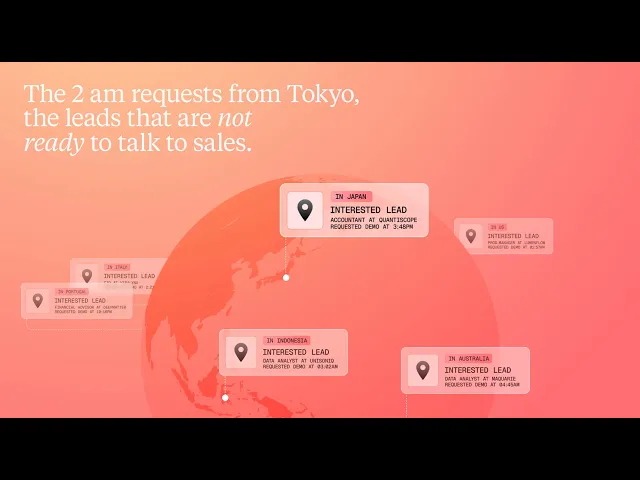
Best for: B2B SaaS marketing and sales teams that want to eliminate the wait between the "Request Demo" click and the actual demo by offering personalized, AI guided product demonstrations on an instant video call 24/7 and in any language.
Karumi is a platform designed to create agentic demos. These are product demonstrations where an AI agent guides the prospect in real time, inside the actual product, during an instant video call. It involves an agent that navigates your software, shows the relevant features, and answers the user's questions while adapting the experience to their profile and interests.
The idea was born from a problem that any B2B sales team knows well. A prospect arrives at your website with genuine interest, clicks "Request Demo", and enters a queue. Someone on the team has to review the lead, qualify it, find a slot on the calendar, and send an invite. By the time the demo actually happens (if it happens at all), their interest has cooled off or the prospect is already evaluating a competitor who showed them the product immediately.
Key features
- Real time AI agent: operates directly on the actual product interface. It does not work with screenshots or clones.
- Automatic profile personalization: the agent asks questions at the beginning of the session to understand the prospect's role, industry, and use case, then adapts the tour based on the answers. Every demo is unique.
- 24/7 availability: the prospect clicks and gets the demo instantly, without depending on a schedule or the sales team's availability.
- Native multilingual support: the agent operates in multiple languages automatically without needing to create separate versions or have native sales reps for each market.
- Automatic lead qualification: every interaction generates qualification data. This includes which features interested them the most, what questions the prospect asked, and how much time they spent on each section.
- Live question answering: the agent does not follow a fixed script. It answers the prospect's questions on the fly and adapts the conversation to the context of what is being shown.
- CRM integration: all the information generated during the demo flows directly into the CRM without manual intervention.
- Live product demo: what the prospect sees is exactly what they will get when they use the product. There are no simulations, no fake data, and no static screens.
- Enterprise security: complies with SOC 2, GDPR, and ISO 27001.
What sets it apart
Karumi creates a new category because while interactive demos offer predefined tours where the user navigates at their own pace along static paths, Karumi offers a dynamic experience where the AI makes decisions at every step based on the context of the conversation. It is the difference between a tour guided by a brochure and a conversation with someone who knows the product inside out.
The demos happen at the moment of peak interest rather than days later, the no show rate practically disappears, and the sales team receives leads who have already seen the product and understand its value.
Tools like Clay and Salesforge, leaders in prospecting and outbound respectively, use Karumi for their own product demos. When the tools that dominate the early stages of the funnel choose Karumi for the demonstration phase, it speaks volumes about the quality of the experience.
5. Attio: Native AI CRM for Modern Teams

Best for: startups, scale ups, and GTM teams that need a flexible CRM that adapts to their sales process (and not the other way around), featuring AI integrated into the data model from day one and without requiring months of implementation.
Attio is a CRM built from the ground up with AI integrated into its data model. It is a platform based on the premise that a CRM should adapt to how your team works, not the other way around. While traditional CRMs force you to fit your process into rigid, predefined structures for contacts, accounts, and opportunities, Attio lets you create custom objects, define relationships between them, and build views that reflect your actual business model.
For sales teams that have tried and abandoned complex Salesforce or HubSpot implementations, Attio offers an alternative that combines the flexibility of a spreadsheet with the power of an enterprise CRM.
Key features
- Custom object based data model: you can create any kind of object (deals, partners, projects, subscriptions) with tailored attributes and relationships.
- AI Attributes: custom fields that automatically fill themselves out using AI. You can configure an attribute to automatically classify each company according to your ICP, summarize the available information about a contact, or research external data like funding stage or headcount.
- Real time data enrichment: contact and company profiles are automatically updated with relevant information, from job title changes to new funding rounds.
- Automation engine: triggers actions based on changes in records, stage transitions, or time rules. This includes assigning leads, scheduling follow ups, and updating statuses.
- Call Intelligence: analyzes sales calls to generate automatic summaries and extract post meeting insights. The AI synthesizes what was discussed and outlines the next steps.
- Collaborative interface: the entire team works on the same data with simultaneous editing, shared notes, timelines, and live updates.
- Flexible views (lists, kanban, timelines): different ways to visualize the same information depending on the role or need. A manager can see a pipeline kanban board, while a rep sees a list filtered by their accounts.
What sets it apart
Attio is probably the most flexible CRM on the market in 2026. Its model based on custom objects allows startups, VC funds, agencies, and SaaS sales teams to build a CRM that reflects exactly their process, without depending on a specialized administrator or months of implementation. Attio lets you set up your CRM from scratch in days, and the AI takes care of keeping the data clean and updated. For teams looking for a CRM that grows with them without becoming an infrastructure project, it is the most coherent option on the market.
6. Gong: Conversation Intelligence and Sales Coaching

Best for: B2B sales organizations with over 10 to 15 reps that need real visibility into what happens during customer conversations, data driven coaching, and forecasting that reflects the reality of the pipeline rather than the subjective estimates of the reps.
Gong is a revenue intelligence platform that captures, transcribes, and analyzes every customer interaction (calls, emails, video calls) to extract actionable insights. Your CRM contains what your team says is happening with the deals. Gong shows you what is actually happening, and that difference between perception and reality is what separates teams that do reliable forecasting from those that get surprises every quarter.
Key features
- Conversation intelligence: every call goes through NLP models trained on billions of real sales interactions. It automatically identifies objections, competitor mentions, buying signals, sentiment, and conversation patterns.
- Gong Forecast: pipeline predictions based on actual conversation data, not on the subjective estimates of the reps.
- Gong Enable: unifies coaching and training in a single platform. It allows you to identify which behaviors correlate with won deals and replicate them across the entire team.
- Gong Engage: a sales engagement module that helps prioritize and personalize outreach using the actual language of the buyers and the pain points detected in conversations.
- Call Spotlight: generates automatic summaries of each call with suggested next steps based on the entire history of the deal.
- AI Data Extractor: automatically creates and updates CRM fields based on the content of the conversations.
- AI Ask Anything: lets you ask natural language questions about your calls, accounts, and deals.
- Topic tracking and team analysis: managers can see what topics come up in won calls versus lost ones, which objections are not being handled well, and at what point in the conversation engagement drops off.
What sets it apart
While most coaching tools are limited to transcription and a summary, Gong offers analysis at the team and organizational level. It not only tells you what happened on a call but also shows you patterns across hundreds of conversations that reveal what is working, what is not, and why.
How can these tools work together?
These six tools are not isolated pieces, because the output of one feeds the input of the next. To see this clearly, let's look at a practical example.
Your company sells project management software for engineering teams in SaaS startups that have just raised their Series A.
- Clay finds the account. You set up a workflow that monitors startups that have closed a round in the last 90 days, have between 20 and 100 employees, and are hiring engineering managers. It cross references over 150 providers, enriches each account with its tech stack, and identifies the decision makers (VP of Engineering, CTO).
- Salesforge reaches out. Agent Frank takes the data from Clay and generates personalized sequences for each decision maker. It sends one email to the CTO mentioning their recent funding round and the challenge of scaling teams. It creates a different one for the VP of Engineering focused on coordination between squads. Everything includes automatic warm up to protect the domain.
- 6sense prioritizes. In parallel, it detects that three of those accounts are already actively researching project management tools. They have visited comparison pages, read reviews, and are consuming content about agile methodologies. It raises their score and alerts the team to prioritize outreach to them.
- Karumi demonstrates. One of those accounts replies to the email and clicks the demo link. Instead of a form and a three day wait, the AI agent initiates an instant video call. It asks them what they work on, shows them the integrations with GitHub and Jira, and highlights the capacity planning dashboard. Fifteen minutes later, it generates a qualification report detailing everything the prospect asked and what interested them the most.
- Attio manages. The demo report reaches the CRM and an opportunity with real context is automatically created. The sales rep who takes the deal knows that the prospect is a post Series A VP of Engineering, that they were interested in integrations, and that their main concern is the adoption curve. The first human conversation begins right where the demo ended.
- Gong analyzes. After the follow up call, Gong detects that the prospect mentioned a competitor twice, that there was an objection about pricing that was not fully resolved, and that sentiment dropped when implementation was discussed. The manager receives these insights and can provide specific coaching on how to handle that objection in future calls.
➡️ Discover how to start using AI in sales.
