
Showing a SaaS product without putting it in the buyer's hands is getting harder every day. Today's buyers do their homework before jumping on a call and demand to see how the tool works before committing their time to an account executive. That is why interactive demo platforms have become a core piece of any go to market team's stack.
Howdygo is one of the most popular tools in the interactive demo space, although its offering might fall short for teams that need deeper customization or more advanced capabilities. Below we share the 6 best Howdygo alternatives in 2026 for teams looking for more depth, automation, or agentic capabilities in their demo programs.
Why are users looking for a Howdygo alternative?
Even though Howdygo covers the basic needs of interactive demo software, there are several reasons why teams end up evaluating other options. Here are the most common ones:
Steep price jumps between plans: The price gap between the starter plan and the higher tiers is significant, and several key HTML features are reserved for the more expensive packages.
Capped monthly AI credits: Howdy AI agent capabilities run on a monthly credit allowance that can quickly run out with heavy use.
No autonomous agent on the real product: Howdygo builds pre recorded demos on an HTML clone but lacks an agent to navigate the live product or adapt the session in real time to the prospect's questions.
Manual maintenance when the product changes: Every major UI update requires re recording or editing the demos to keep them aligned with the current software version.
Limited depth in complex flows: When the product involves conditional logic, real time data, or custom configurations per client, the HTML format can fall short compared to more sophisticated solutions.
Focused on early stages: The tool handles the discovery phase well but fails to support the prospect in later stages that require technical interaction or functional validation of the product.
What are the best Howdygo alternatives?
Below is our list of the best Howdygo alternatives in 2026, designed for teams looking for more automation, technical depth, or agentic capabilities in their demo programs.
Software | Demo type | Autonomous AI agent | Navigates real product live | Real-time personalization | Security |
|---|---|---|---|---|---|
Karumi | Agentic demo via video call | ✅ In production | ✅ Yes | ✅ Adapts interface and journey live | SOC 2, GDPR, ISO 27001 |
Arcade | Interactive demos, product content | ❌ No | ❌ Pre-recorded captures | ⚠️ Manual personalization | SOC 2, GDPR |
Storylane | Interactive tours, Hubs (deal rooms) | ⚠️ RepX (conversational AI) | ❌ Cloned environment | ⚠️ Predefined flows per profile | SOC 2 Type II, GDPR |
Supademo | Interactive tours, sandboxes, videos | ⚠️ AI Demo Agent (pre-recorded content) | ❌ Pre-recorded content | ⚠️ Dynamic variables | SOC 2 Type II, GDPR, CCPA |
Navattic | HTML cloning, sandboxes | ⚠️ Agent Demos | ❌ Cloned environment | ⚠️ Dynamic variables | SOC 2 Type II, GDPR |
Consensus | Video demos, tours, simulations | ⚠️ Conversational layer (Peel) | ❌ Pre-recorded content | ⚠️ Content prioritized by profile | SOC 2 Type II, GDPR |
1. Karumi
Karumi has defined its own category within the demo space, known as agentic demos. An autonomous AI agent takes control of the real product and guides the prospect just like an experienced sales engineer would.
The session happens live, without any pre recorded videos or HTML walkthroughs built on a front end clone. The agent navigates the interface, performs actions, answers questions, and tweaks the journey on the fly based on what the user wants to see.
The main difference compared to Howdygo is that Karumi does not rely on pre recorded sandboxes or HTML recreations of the product. The agent operates on the real app during a video call, shows exactly the functionality the prospect asks for, and adjusts the content to their context without any manual work from the sales team.
Key highlights
Live product demos: The agent works directly on the software interface to show features and answer questions without human intervention.
24/7 availability: Any prospect can start a demo whenever they want, eliminating sales team bottlenecks.
Contextual personalization: Each session adapts to the user's industry, role, and interests to deliver a unique journey instead of a fixed sequence.
Multilingual communication: The agent converses natively in the prospect's language without needing separate versions for each market.
Automatic CRM syncing: Data from every interaction flows right into Salesforce, HubSpot, or other tools with no extra steps.
Buying intent detection: It analyzes user behavior during the session to identify the leads with the highest potential.
Automatic updates reflected: When the product changes, the demo reflects it so nobody has to manually re record or edit the content.
User governance and permissions: It controls who can access, edit, or manage each demo across the organization.
Complete activity logging: It documents every action to make audits, tracking, and traceability much easier.
Security certifications: It operates under SOC 2, GDPR, and ISO 27001 standards.
➡️ Read our dedicated article comparing Karumi vs. Howdygo.
2. Arcade
Arcade is a no code platform built for the fast creation of interactive demos and product content. Its visual editor allows marketing, sales, and product teams to capture real software flows, add interactive elements, and publish guided experiences ready to share with prospects or clients at different stages of the funnel.
Its approach ensures that anyone on the team can build demos without relying on technical roles, and it includes options to enrich the content with narration, videos, or visual assets alongside metrics that show how users interact with each piece.
Key highlights
No code creation: Marketing, sales, and product teams can build complete demos without depending on developers or design resources.
Visual capture and editing: The initial recording becomes an editable asset where you can tweak text, frame sections, and add CTAs right over the interface.
AI enriched content: It handles the narration and post production work for the asset by generating voiceovers, short videos, and graphical elements directly from text.
One capture creates multiple outputs: A single recording can be reused to build interactive demos, downloadable videos, GIFs, and campaign assets without having to start over.
Detailed analytics: It provides visibility into viewer behavior within the demo, tracking everything from clicks and time spent on each step to early drop offs.
Stack integrations: It connects with major marketing, sales, and analytics tools to feed interaction data straight into your CRM.
Flexible distribution: The output can be published as an embedded web demo, a downloadable video, a GIF, or a custom link for emails and campaigns.
Security and compliance: It meets the SOC 2 and GDPR frameworks required in enterprise environments.
3. Storylane
Storylane is one of the platforms with the broadest offering in the space of no code interactive demos. It lets you generate walkthroughs using screenshots, videos, HTML clones, and sandboxes all from a single tool, featuring an integration ecosystem that connects with over 17 marketing and sales platforms to fuel the entire funnel.
Its recent evolution has taken the platform beyond the classic embedded demo use case. Today it combines Hubs (custom deal rooms filled with demos, videos, and documents) with RepX, a conversational AI agent that qualifies leads from the website and routes them to the sales team.
Key highlights
No code creation: Marketing, sales, or presales teams can capture the product right from the browser and build walkthroughs without touching a single line of code.
Guided walkthroughs: The demo is built step by step using hotspots, tooltips, and interactive elements that guide the user across the interface.
Profile based segmentation: Each demo can display different paths, messages, and features depending on the prospect's role, industry, or use case.
Visual and multimedia editor: It lets you combine captures, videos, GIFs, and forms into the same asset while also allowing text edits without having to re record.
AI applied to content: The AI generates narrations, translations, and summaries to enrich the asset, though it does not act as an autonomous agent within the product.
Hubs and RepX: It blends custom deal rooms for the buying committee with a conversational agent that captures intent and routes leads directly to the sales team.
Embedded distribution: The demo can be published as a direct link, embedded on the website, or dropped into emails, CRMs, and other touchpoints.
Enterprise security: It complies with SOC 2 Type II and GDPR, offering SSO, custom domains, and advanced permissions on higher tier plans.
4. Supademo
Supademo allows you to build interactive demos from a recorded flow using its browser extension. It supports multiple formats within the same account, including clickable walkthroughs, sandboxes, AI generated videos, and offline demos for events with no internet connection.
In June 2026, it launched its AI Demo Agent, an always on conversational agent that qualifies buyers, answers technical questions, and delivers demo content in real time. The agent works on top of pre recorded demos and does not navigate the live product the way other solutions do.
Key highlights
Browser capture: The extension records any software flow and turns it into an interactive demo in just a few minutes.
Multiple formats: It mixes HTML clones, screenshots, video, sandboxes, and offline demos all inside the same editor.
AI Demo Agent: A 24/7 conversational agent that qualifies intent, answers questions, and serves up the right demo based on the visitor's profile.
Dynamic variables and branching: It customizes names, logos, and pathways within a single base demo to fit thousands of prospects.
Voiceovers in 15 plus languages: The AI generates automatic narrations to cover international markets without needing to re record audio.
Sales stack integrations: It connects with HubSpot, Salesforce, and other marketing tools to centralize interaction data.
Account level analytics: It measures engagement per viewer and also aggregates it at the account level to help you understand buying committee behavior.
Robust compliance: It complies with SOC 2 Type II, GDPR, and CCPA.
5. Navattic
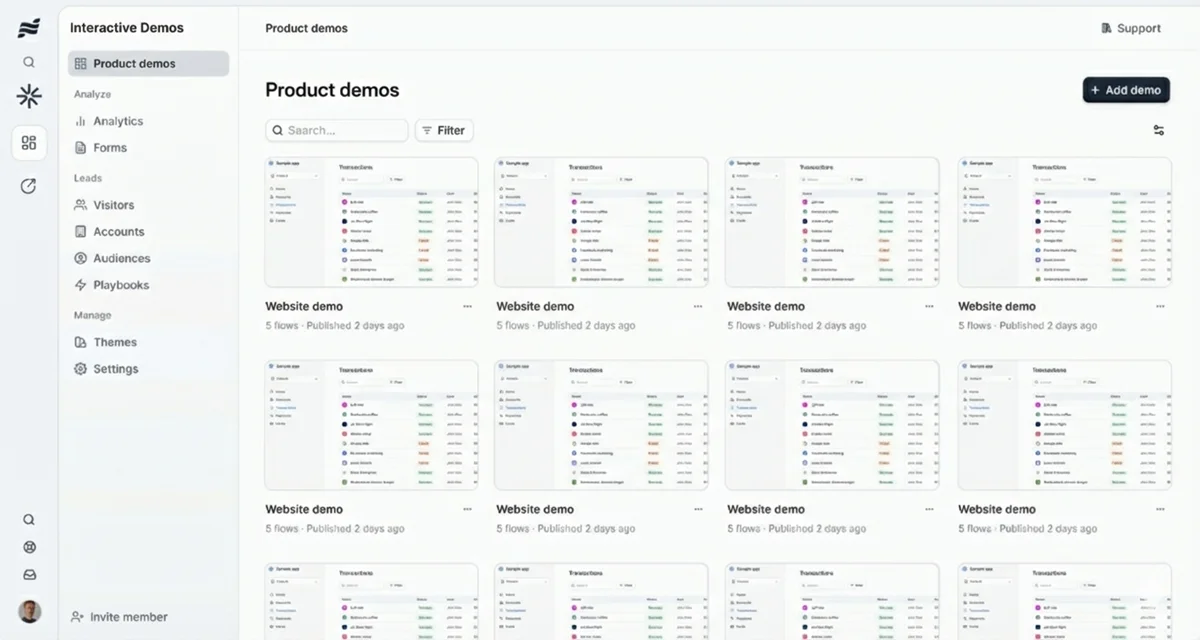
Navattic is a no code platform for creating interactive demos geared toward marketing, sales, and presales teams. Its HTML cloning technology captures the real front end of the product and creates demos with much higher visual fidelity than screenshot based tools.
In 2026, it rolled out Agent Demos, a conversational AI layer that autonomously guides the prospect through cloned environments, alongside Launchpad, which lets sales engineers share the right demo based on the deal stage.
Key highlights
Front end HTML cloning: It captures the actual interface code and produces demos that keep hover states, animations, dropdowns, and scrolling intact.
Visual content editing: Text, images, and data can be modified right inside the demo without having to re record the original flow.
Agent Demos: A conversational AI layer that operates over the cloned environment and guides the prospect autonomously.
AI Copilot for creation: It helps with copywriting, anchoring tooltips, and structuring the walkthrough.
Embedded distribution: Demos are shared via a custom link or embedded in websites, emails, and campaigns.
Dynamic personalization: Variables like name, role, or logo make it easy to adapt the demo to each buyer profile.
Enterprise compliance: It operates under SOC 2 Type II, GDPR, SSO/SAML, and includes audit logs on the Enterprise plan.
6. Consensus
Consensus is a demo automation platform aimed at sales and presales teams dealing with complex buying cycles and multiple stakeholders. Its product brings together on demand demo videos, interactive product tours, and automated simulations with a tracking system that measures how the demo gets distributed across the buying committee.
In April 2026, it announced the acquisition of Peel to bring a conversational AI layer to existing content and push toward a more interactive demo format.
Key highlights
On demand demo videos: Buyers can access pre recorded demos tailored to their industry or use case without having to wait for a call.
Interactive product tours: Clickable walkthroughs that showcase key features and let buyers explore the product at their own pace.
Automated simulations: Navigable environments where buyers can dive deep into specific software flows.
Profile based personalization: The demo prioritizes relevant information depending on the role and interests the visitor provides.
Buying committee tracking: It figures out which stakeholders are watching the demo within each account via intra viral sharing.
AI applied to optimization: The AI tweaks pre defined paths based on user behavior, without a live agent interacting.
Revenue stack integrations: It connects with top CRMs and marketing platforms to sync engagement data.
Enterprise compliance: It complies with SOC 2 Type II and GDPR.

Accelerate your growth with
AI-led demos.
Launch your demo in 5 minutes!
Launch your demo in 5 minutes!

Don’t make your prospects wait–ever again. Scale your demos and increase your revenue.



" height="18.00002px" id="t3TUwhEsx" transform="translate(3 3.243)" width="18px"/></svg>)
" height="16.00002px" id="eM6xJX0fQ" transform="translate(3 4.243)" width="18px"/></svg>)
" height="23.33220463282985px" id="JFXEvpVdY" transform="translate(0.489 0.333)" width="23.02237881352199px"/></svg>)
" height="23.866674065589905px" id="K2XP5s9Up" transform="translate(0 0.133)" width="23.852008219791px"/></svg>)
 scale(1 1) translate(--0.05666666666666667, -0.2982222222222222)" id="Azbtm4YKc-3318398759-radial-gradient" r="1.0639022167225811"><stop offset="0" stop-color="rgba(0, 0, 0, 0)"/><stop offset="1" stop-color="rgb(0, 0, 0)"/></radialGradient></defs><path d="M 0 0 L 24 0 L 24 24 L 0 24 Z" fill="transparent" height="24px" id="Dan82935g" width="24px"/><path d="M 11.996 24 C 12.008 22.39 11.681 20.795 11.036 19.32 C 10.44 17.896 9.573 16.6 8.483 15.507 C 7.392 14.419 6.101 13.554 4.68 12.96 C 3.205 12.315 1.61 11.987 0 12 C 1.607 12.013 3.2 11.695 4.679 11.067 C 6.098 10.453 7.388 9.577 8.483 8.485 C 9.57 7.392 10.437 6.1 11.036 4.68 C 11.681 3.205 12.008 1.61 11.996 0 C 11.996 1.663 12.304 3.223 12.929 4.68 C 13.542 6.099 14.417 7.39 15.508 8.485 C 16.606 9.577 17.899 10.452 19.321 11.065 C 20.802 11.69 22.393 12.008 24 12 C 22.39 11.988 20.796 12.315 19.321 12.96 C 17.897 13.554 16.602 14.419 15.508 15.507 C 14.417 16.605 13.542 17.898 12.929 19.32 C 12.305 20.801 11.987 22.393 11.996 24 Z" fill="url(%23Azbtm4YKc-3318398759-radial-gradient)" height="24px" id="Azbtm4YKc" width="24px"/></svg>)
© 2026 Karumi. All rights reserved.