
Interactive product demos allow you to showcase how software works without relying on static presentations or pre-recorded videos. Through guided walkthroughs, users can explore the interface and understand the product at their own pace.
Storylane is one of the most popular no-code tools for creating these demos, especially within SaaS environments. However, it isn't always the best fit depending on the type of product, the team using it, or the specific goals of the demo.
In this article, we review the 7 best Storylane alternatives in 2026, analyzing their key features and the scenarios where each tool shines most.
Why are users looking for a Storylane alternative?
While Storylane is a well-known tool for creating interactive product demos, many teams begin evaluating other options as their needs and use cases evolve. Below, we analyze the most common reasons why users seek an alternative to Storylane:
Pricing structure and scalability: storylane's costs can increase significantly as advanced features become necessary.
Ongoing demo maintenance: screenshot-based demos require frequent updates every time the product’s interface changes.
Visual fidelity and design: some users encounter limitations regarding capture resolution and visual customization options.
Depth of analytics: other platforms offer more granular analysis of user behavior than what is available in Storylane.
Analytics and intent signals: while Storylane includes usage metrics, there are alternatives that provide deeper insights into user behavior and buying intent.
Restrictive free plan: the free tier limits the number of published demos, making it difficult to test different use cases before committing to a paid plan.
Support on basic plans: entry-level plans offer more limited support options compared to higher-priced tiers.
What are the best Storylane alternatives?
Here, we review the top Storylane alternatives for 2026, highlighting their key features, advantages, and most common use cases.
Software | Demo type | AI usage | Real-time interaction | Multilingual (effort) | Security |
|---|---|---|---|---|---|
Karumi | Agentic demo | High / Autonomous: an AI agent navigates the real product, reasons, and responds to prospects in real time. | Yes: the agent adapts the demo and answers questions live. | Native & automatic: multilingual support without extra setup. | SOC 2, GDPR, ISO 27001 |
Navattic | Interactive demo | Low / Personalization: AI limited to personalizing preconfigured content. | No: users follow predefined flows with no dynamic response. | Manual: each demo must be adapted per language. | SOC 2 Type II |
Arcade | Interactive demo | Low / Personalization: minimal AI usage, mainly focused on visual creation. | No: guided walkthroughs without real-time interaction. | Manual: demos must be translated individually. | SOC 2, GDPR |
Supademo | Interactive demo | Low / Personalization: AI used for basic adjustments to static content. | No: guided navigation without live adaptation. | Manual: separate demos per language. | SOC 2 Type II |
Consensus | Interactive demo | Low / Personalization: AI adapts demo paths based on user input, without autonomous agents | No: personalization is input-based, not real-time interaction. | Manual: language adaptation per demo. | SOC 2 Type II, GDPR |
Reprise | Interactive demo | Low / Personalization: no autonomous AI, focused on reusable demos. | No: interactive experiences without live responses. | Manual: translation and management per demo | SOC 2 Type II, GDPR |
Demostack | Interactive demo | Low / Personalization: limited AI usage, no autonomous behavior. | No: free exploration in sandboxes, without real-time response. | Manual: each demo must be adapted per language. | SOC 2 Type II, GDPR, CCPA |
1. Karumi.ai
Karumi is a platform that allows you to create agentic demos which are video calls where an AI agent performs a product demonstration for the prospect in real time. Instead of relying on screenshots or static presentations, the agent can navigate the product, answer questions, and adapt the demo based on user interaction.
Designed for sales and marketing teams, this tool makes it easy to offer personalized product demos at any time without depending on a human presenter. Its multilingual support along with voice and reasoning capabilities allow the demo to become an active experience where the product explains itself without the need for pre-recorded videos.
Key highlights
24/7 availability: demos can be performed at any time without depending on the schedule of a human representative.
AI agent in video: calls: an artificial intelligence agent guides the prospect during the call while showing the product and answering questions in real time.
Real time personalization: the presentation adjusts to the profile and needs of each prospect. The content and pace of the demo change according to the questions and interactions of the user.
Data collection: the platform records engagement and prospect behavior to facilitate follow up.
Multilingual communication: the agent can interact in different languages which allows you to reach international audiences.
Automatic updates: the agent always reflects changes and new product features by showing the most recent version.
CRM integration: data from each demo syncs with sales and marketing tools to optimize workflows.
Advanced access control: manage roles and permissions so that each team member only accesses the information and features they need.
Audit logs: maintain a detailed history of all actions performed on the platform to ensure traceability and control.
Security compliance: the platform complies with standards such as SOC 2, GDPR, and ISO 27001 to guarantee privacy and data protection.
➡️ Read our dedicated article comparing Karumi vs. Storylane.
2. Navattic
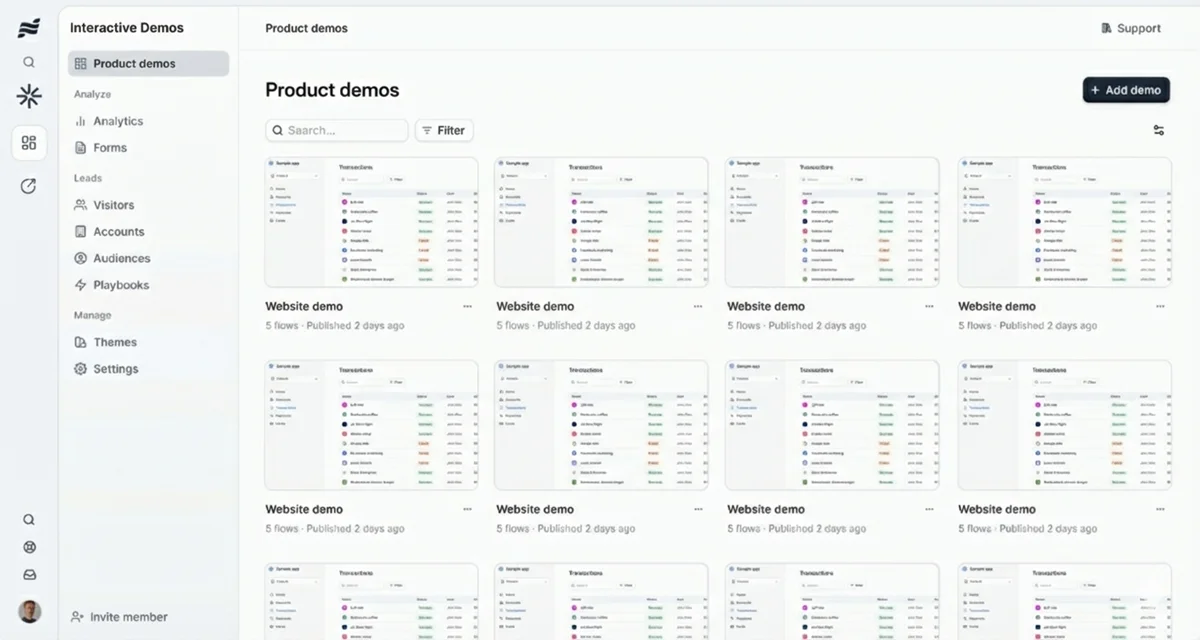
Navattic is a platform that allows you to create no code product demos directly in the browser. Instead of relying on videos or static captures, it converts real software flows into guided experiences that prospects can explore on their own.
Navattic helps present the product more effectively and drives the buying process forward. Its demos can be personalized based on the prospect profile and easily shared at different points in the sales cycle to accelerate decision making.
Key highlights
No code demos: Navattic allows you to create complete product demos without the need for programming which speeds up how teams present software to prospects.
Reusable templates: the platform offers predesigned templates and tools to reuse content reducing the production time for new demos.
User analytics: it provides detailed metrics on how prospects interact with the demos including clicks, session time, and engagement levels to help optimize the presales process.
Limited AI usage: artificial intelligence only assists in generating content within the demos and does not offer automated interaction during the user experience.
Team collaboration: multiple team members can work together on creating and editing demos with integrated functions for organization and project management.
Tool integrations: it connects natively with CRMs and marketing platforms to optimize workflows.
Security and compliance: it complies with standards such as GDPR and implements access controls and data protection for secure enterprise use.
3. Arcade
Arcade is a no code platform that allows you to create interactive demos and product content. With its visual editor, marketing, sales, and product teams can capture application flows, add callouts, and publish self guided demos ready to share with customers.
Its visual interface makes it easy to capture and edit product steps, add interactive elements, and publish demos quickly. Additionally, it allows you to measure user interaction to support the presales process and lead generation.
Key highlights
No code creation: it allows you to build complete interactive demos without needing to know how to program which speeds up the production of product content.
Recording and visual editing: it allows you to capture real application flows and edit them with elements such as hotspots, chapters, and calls to action.
Flexible distribution: share demos through personalized links, embed them in websites, or export them as GIFs or video for other channels.
Integrated analytics: it offers metrics on user interaction including clicks, session time, and drop off points to better understand the performance of each demo.
Team collaboration: multiple members can work together on the creation and management of demos within a shared space.
Tool integrations: it connects with sales, marketing, and analytics platforms to enrich workflows and share data.
Security and compliance: Arcade holds SOC 2 certification and complies with GDPR for data protection and privacy.
4. Supademo
Supademo is an interactive demo platform that helps teams quickly create product tours using a browser extension. It automatically captures workflows and transforms them into step by step guides that combine video, screenshots, and interactive elements.
The tool stands out for its simplicity and allows users to generate professional demos without extensive technical knowledge. Its ease of use and customization options help better capture prospect attention and accelerate the sales process.
Key highlights
Interactive and tailored experiences: the platform supports conditional branching and dynamic variables that allow teams to customize the content and the demo path according to the specific profile of the prospect.
Diverse demo formats: users can build presentations using HTML captures, video, or screenshots as well as a hybrid approach to find the right balance for each use case.
Limited AI application: Supademo uses artificial intelligence primarily for text generation, voiceovers, and translations within the demos but lacks an autonomous agent capable of interacting with prospects in real time.
Integration with other tools: it features native connections with leading sales and marketing tools to streamline lead management and data flow.
Detailed tracking and metrics: the system provides comprehensive analytics to monitor metrics such as engagement levels, drop off rates, and conversion performance.
Centralized collaboration: through shared workspaces, multiple team members can collaborate on product demonstrations.
Enterprise security and privacy: Supademo complies with various global security standards including SOC 2 Type 2, GDPR, and CCPA.
5. Consensus
Consensus is an automated demonstration platform that allows potential customers to explore products on their own based on their needs and interests. Each demo adjusts dynamically to show only relevant information, eliminating content that does not add value.
The tool is designed for sales and presales teams managing complex buying processes with multiple stakeholders. By offering on-demand demos personalized for each prospect, Consensus facilitates engagement, accelerates decision making, and communicates product value more effectively.
Key highlights
On demand demos: it allows prospects to explore the product autonomously without relying on pre-recorded videos or static screenshots.
Personalized content: each demo adapts to the profile and decisions of the user, showing only relevant information and removing anything superfluous.
Behavior tracking: it records which sections of the demo users view, how much time they spend on each part, and how they interact.
Limited AI scope: artificial intelligence is used solely to optimize preconfigured demos as there are no AI agents interacting with users in real time.
CRM and marketing integrations: demo data syncs with major sales and marketing platforms.
Security and compliance: the platform complies with standard security requirements such as SOC 2 Type 2 and GDPR.
6. Reprise
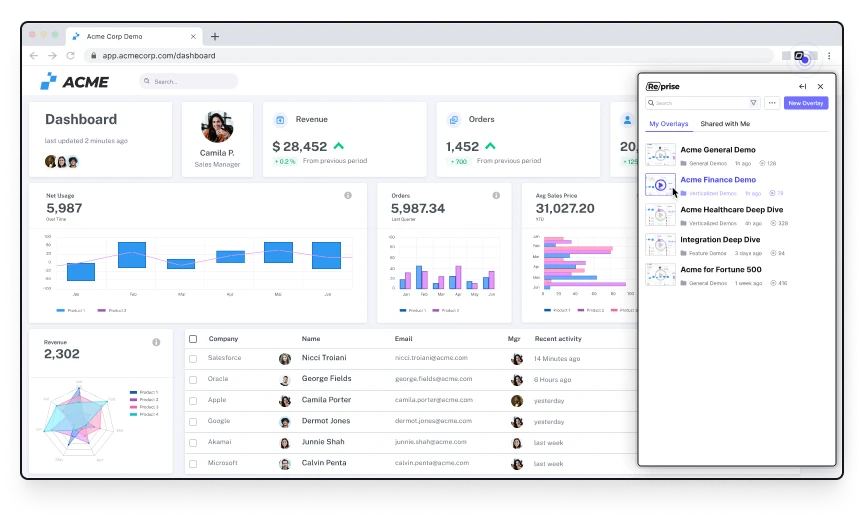
Reprise is a platform that allows you to create interactive and reusable product demos without relying on technical teams. It captures and clones the front end of the application to generate navigable demos that function like the real product.
It is designed for sales and marketing teams that need to offer consistent and scalable demos. The platform makes it easy to edit and adjust demos, add interactivity, and share them across different stages of the sales process.
Key highlights
No code demos: it allows for the creation of interactive and reusable demos without the need for advanced technical knowledge.
Easy editing and adjustments: teams can modify flows, replace screens, and keep demos updated without rebuilding them from scratch.
Interactive experiences: add hotspots, text, buttons, and other elements so that prospects can explore the product dynamically.
Flexible sharing: demos can be distributed via links, embedded on websites, or exported for other channels.
Integrated analytics: it offers metrics on user interaction including clicks, session time, and the most viewed sections.
Team collaboration: multiple members can work together on the creation and management of demos within a shared space.
Security and compliance: it complies with standards such as SOC 2 Type 2 and GDPR ensuring privacy and protection for both company and user data.
7. Demostack
Demostack is a platform that allows sales and marketing teams to create personalized product demos without depending on technical teams. It offers various formats such as cloned demos, guided tours, and sandbox environments.
It is designed for organizations that want to showcase product value at every stage of the sales cycle. Teams can build and share demos for different use cases and measure the impact of every interaction.
Key highlights
No code demos: the platform allows you to create personalized product experiences without needing engineering support.
Cloned environments and overlays: it offers options to clone the real product or use overlays on top of the live application.
Interactive sandboxes: prospects can explore the product within real test environments.
Integrated analytics: it provides data on usage, engagement, and demo performance to refine commercial strategies and measure pipeline impact.
GTM tool integration: it connects with CRMs, marketing platforms, and other tools to sync data and facilitate lead follow up.
Security and compliance: it complies with standards such as SOC 2 Type II, GDPR, and CCPA to ensure data protection and secure enterprise use.

Accelerate your growth with
AI-led demos.
Launch your demo in 5 minutes!
Launch your demo in 5 minutes!

Don’t make your prospects wait–ever again. Scale your demos and increase your revenue.



" height="18.00002px" id="t3TUwhEsx" transform="translate(3 3.243)" width="18px"/></svg>)
" height="16.00002px" id="eM6xJX0fQ" transform="translate(3 4.243)" width="18px"/></svg>)
" height="23.33220463282985px" id="JFXEvpVdY" transform="translate(0.489 0.333)" width="23.02237881352199px"/></svg>)
" height="23.866674065589905px" id="K2XP5s9Up" transform="translate(0 0.133)" width="23.852008219791px"/></svg>)
 scale(1 1) translate(--0.05666666666666667, -0.2982222222222222)" id="Azbtm4YKc-3318398759-radial-gradient" r="1.0639022167225811"><stop offset="0" stop-color="rgba(0, 0, 0, 0)"/><stop offset="1" stop-color="rgb(0, 0, 0)"/></radialGradient></defs><path d="M 0 0 L 24 0 L 24 24 L 0 24 Z" fill="transparent" height="24px" id="Dan82935g" width="24px"/><path d="M 11.996 24 C 12.008 22.39 11.681 20.795 11.036 19.32 C 10.44 17.896 9.573 16.6 8.483 15.507 C 7.392 14.419 6.101 13.554 4.68 12.96 C 3.205 12.315 1.61 11.987 0 12 C 1.607 12.013 3.2 11.695 4.679 11.067 C 6.098 10.453 7.388 9.577 8.483 8.485 C 9.57 7.392 10.437 6.1 11.036 4.68 C 11.681 3.205 12.008 1.61 11.996 0 C 11.996 1.663 12.304 3.223 12.929 4.68 C 13.542 6.099 14.417 7.39 15.508 8.485 C 16.606 9.577 17.899 10.452 19.321 11.065 C 20.802 11.69 22.393 12.008 24 12 C 22.39 11.988 20.796 12.315 19.321 12.96 C 17.897 13.554 16.602 14.419 15.508 15.507 C 14.417 16.605 13.542 17.898 12.929 19.32 C 12.305 20.801 11.987 22.393 11.996 24 Z" fill="url(%23Azbtm4YKc-3318398759-radial-gradient)" height="24px" id="Azbtm4YKc" width="24px"/></svg>)
© 2026 Karumi. All rights reserved.