

Karumi vs Hexus: what are the differences?

Few things influence a B2B sale as much as the moment the buyer sees the product for the first time. Today, that buyer wants to explore it as soon as they show interest, without waiting and on their own terms, and this expectation has led many teams to incorporate AI into their demos so they don't depend on schedules or manual processes.
Karumi and Hexus are two of the platforms tackling this challenge, each with its own approach. In this article, we review what each one does and where their main differences lie.
What is Karumi?
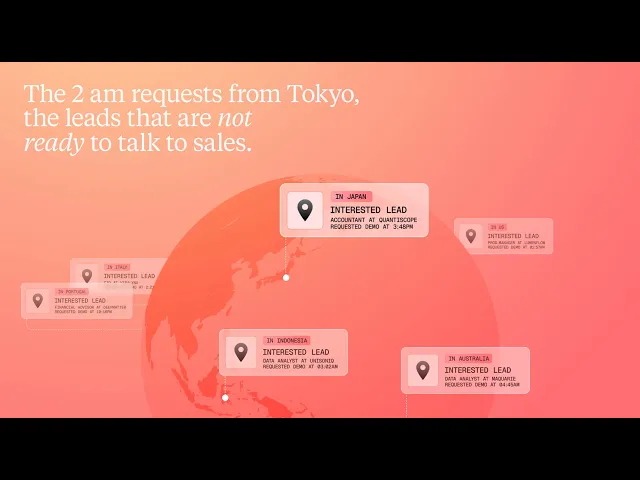
Karumi is the product that gave its name to a new category within demo software, known as agentic demos. Its approach breaks away from the usual format where a sales rep schedules a session or the prospect settles for a static video. Here, an AI agent takes the lead, guiding each visitor through the product, highlighting what truly interests them based on their profile, and answering questions as they arise.
The nuance that changes everything is the setting where it happens. Instead of relying on a mockup or recorded screens, the agent operates directly on the live version of the software. That allows it to enter real flows, justify what each section is for, and hold a real dialogue rather than a guided tour on rails. The person on the other side decides which way to go and asks whatever they want whenever they want.
With this model, a single demo no longer has capacity limits. It works at any time of day, adapts to whoever requests it, and does not require any team member to be present to happen.
Key features of Karumi
- Real time agentic demos: the agent navigates the product, showcases each capability, and resolves the prospect's doubts right in the middle of the session.
- Context adaptation: it reads the industry, role, and interests of the person in front of it and reorganizes the journey on the fly without manual preparation.
- Automated lead qualification: it observes how the visitor behaves during the demo and translates those signals into intent data for the sales team.
- CRM synchronization: it dumps what happened in the session directly into Salesforce, HubSpot, or other tools without intermediate tasks.
- Automatic updates: if the software changes, the demo picks it up instantly without redoing flows or manually replacing screenshots.
- Multilingual support: the agent assists in the prospect's language, opening up new markets without setting up a local team.
- 24/7 availability: the lead launches the demo right when their interest peaks, without queues or depending on anyone's schedule.
- Permission management: you decide what each user sees by distributing access according to their role or stage in the cycle.
- Complete traceability: every movement is recorded so you can audit usage and know exactly what information has been shared.
- Enterprise security: it complies with SOC 2, GDPR, and ISO 27001, aligning with the strictest privacy and data protection requirements.
What is Hexus?
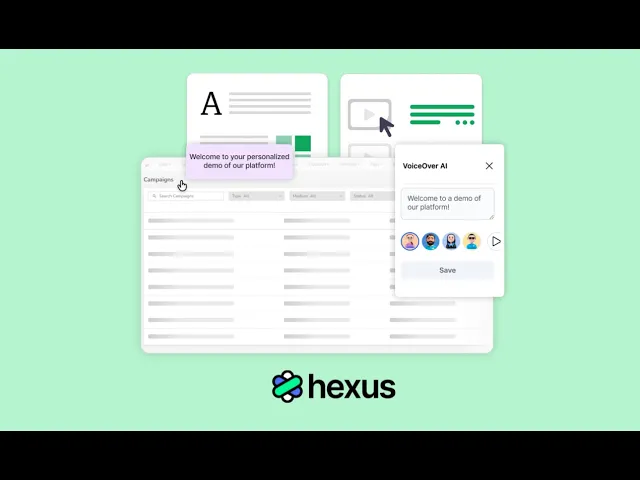
Hexus is an AI platform to create product content from screen recordings and material you already have. Using the same source, it generates interactive demos, videos, and guides, allowing you to repurpose each piece into other formats with a single click.
The workflow revolves around capturing once and adapting many times. You record the walkthrough with their Chrome extension or upload an existing video, and Hexus turns it into an editable interactive demo where you add hotspots, CTAs, forms, and personalization variables. From there, you transform that demo into a step by step guide, a video, or a landing page without recording again.
It is worth keeping a clear distinction in mind. The Hexus demo is built on product screenshots, not the live interface. The prospect clicks through a prefabricated path, rather than exploring the actual software or receiving answers from an agent during the session.
Key features of Hexus
- Video to demo converter: it transcribes and transforms screen recordings or videos into interactive and editable demos in just a few minutes.
- Content repurposing: it converts a single piece into demos, videos, guides, posts, and emails without redoing the original work.
- No code visual editor: you adjust texts, data, screenshots, and design from an HTML editor without relying on technical teams.
- Variable personalization: it adapts names, data, and messages to each ICP or use case by configuring it beforehand.
- AI analytics: it measures drop off, conversions, engagement, and the user journey to refine the go to market strategy.
- Broad integrations: it connects with HubSpot, Salesforce, Slack, Zapier, Notion, Wistia, or Google Analytics, among over a hundred applications.
- Multilingual localization: Enterprise plans include translation into several languages to distribute the same content across different markets.
- Enterprise security: it incorporates security and compliance controls designed for large accounts.
Karumi vs Hexus: which one should you choose?
Ultimately, deciding between Karumi and Hexus has less to do with which is "better" and more to do with what role you want the demo to play in your process. One focuses on the conversation with the product in front of you, the other on producing and maintaining content at scale. These guidelines will help you find your bearings.
Choose Karumi if:
- You want the lead to touch the product as soon as possible: you want any interested party to open a guided demo the instant they request it, without being at the mercy of the sales schedule.
- You are looking for a demo that reconfigures itself for each buyer: you prefer the journey and messages to change depending on who enters, without leaving versions prepared beforehand.
- You care about the sales intelligence of each session: you want to capture buying signals as the demo happens and have them travel to your CRM on their own.
- You operate in multiple languages: you need the experience to work natively in the prospect's language without cloning content or adding local headcount.
- You do not want to maintain demos manually: you assume that when the product changes, the demo will update itself without anyone touching flows or screenshots.
- You prefer to filter before meeting: it suits you to have the lead go through an autonomous demo that measures their real interest and saves meetings for the accounts with the most potential.
- You want AI to lead, not just assist: you are drawn to artificial intelligence driving the entire experience within the real product from start to finish.
Choose Hexus if:
- You produce product content non stop: you constantly need demos, videos, and guides, and you want to get them from a single recording.
- You want to squeeze every piece into multiple formats: you are interested in converting a demo into a guide, video, or marketing material without starting from scratch every time.
- Your bottleneck is technical dependency: you prefer marketing or sales to create and edit assets without waiting for design or engineering.
- You bet on self service: you are looking for walkthroughs, demo centers, and help documentation so the customer can advance on their own.
- Leave behinds are useful to you: you want to leave interactive and personalized material after each meeting to keep the deal alive.
- You want all content centralized: you prefer to unify creation, editing, and analytics in a single tool.
